How to read a hallmark
Reading a silver hallmark is like decoding a little identity card stamped into the metal. Once you know what to look for, you can tell what it’s made of, where it was assayed, who made it, and even the year.
🔍 What a Typical Hallmark Looks Like
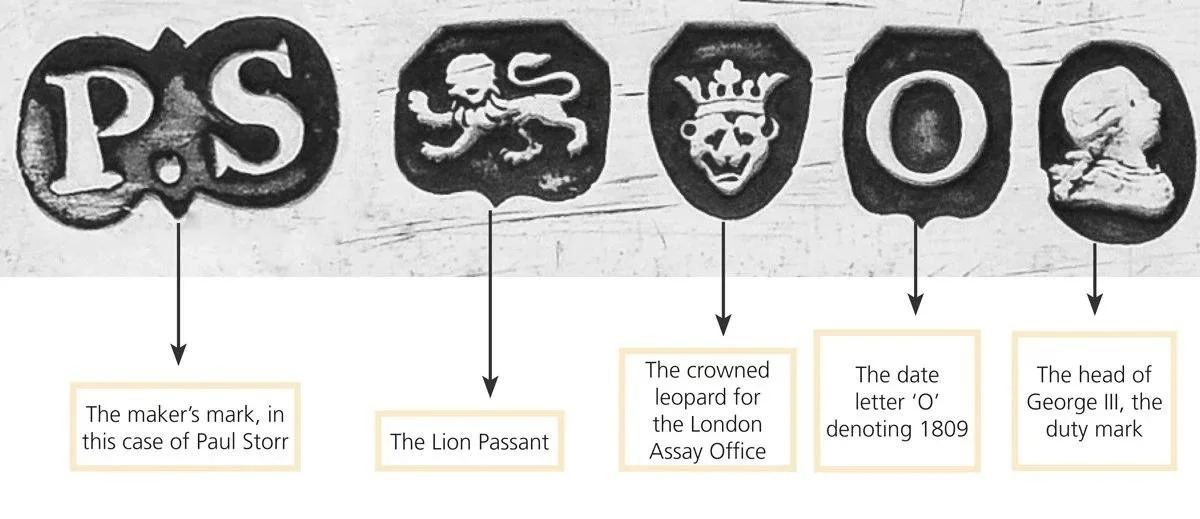
A full (traditional UK) hallmark usually has 4–5 symbols in a row:
Maker’s mark – who made it
Purity mark – how much silver it contains
Assay office mark – where it was tested
Date letter – the year it was hallmarked
(Optional) Duty mark – a tax mark (older pieces only)
🪙 1. Purity (What the Silver Is Made Of)
This is often the easiest to recognise:
“925” → Sterling silver (92.5% pure)
“958” → Britannia silver (higher purity)
A lion passant (walking lion) → traditional UK sterling standard
👉 If you see EPNS (Electroplated Nickel Silver), it’s not solid silver—just plated.
🏛️ 2. Assay Office (Where It Was Tested)
Each UK city has its own symbol:
Anchor → Birmingham
Leopard’s head → London
Castle → Edinburgh
Rose → Sheffield
This tells you where the silver was officially checked.
🏷️ 3. Maker’s Mark (Who Made It)
Usually initials inside a shape (e.g., “T & Co” or “JS”)
The shape of the stamp (oval, shield, rectangle) also matters
You can look these up in hallmark databases to identify the silversmith
📅 4. Date Letter (When It Was Made)
A single letter (e.g., “a”, “B”, “q”)
The font and shape around it change every year
Each assay office has its own cycle
👉 You usually need a chart to match the exact year.
👑 5. Duty Mark (Older Pieces Only)
A small profile of a monarch (e.g., King George III)
Shows tax was paid on silver (used 1784–1890)
🧠 Putting It All Together
If you had a spoon marked:
Lion passant → sterling silver
Anchor → Birmingham
“JH” → maker
Date letter “g” → specific year from chart
👉 You could say: “This is a sterling silver spoon, assayed in Birmingham, made by JH in [year].”
⚠️ Quick Tips
Hallmarks are often tiny—use a magnifying glass
They may be worn or partially missing on antiques
Not all countries use the same system (UK is one of the most detailed)